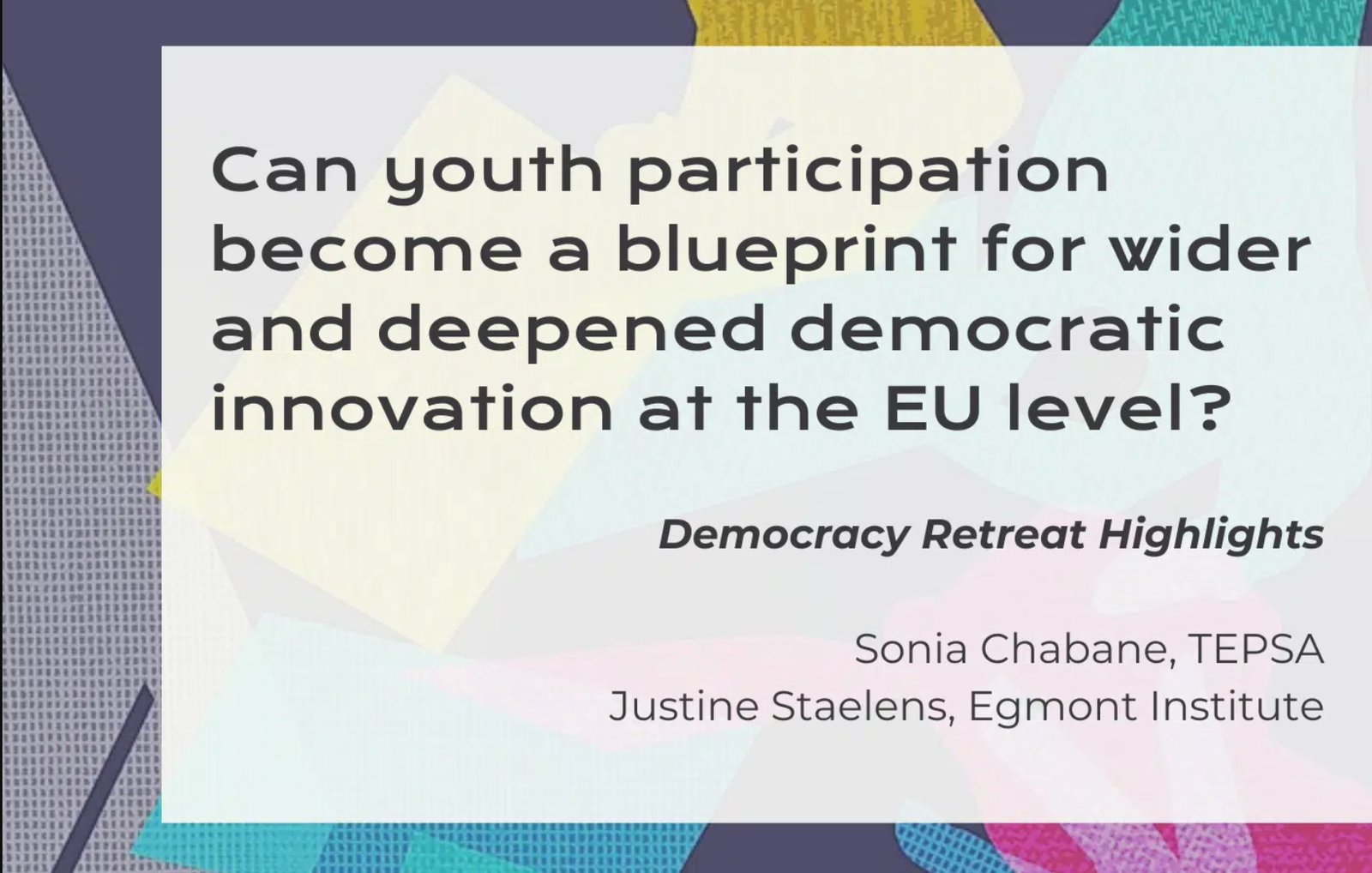
Youth participation is increasingly viewed as a potential catalyst for democratic renewal in the European Union (EU), including through the upcoming EU’s Intergenerational Fairness Strategy. The issue has gained urgency as democracies worldwide face sustained pressures and the legitimacy of democratic institutions is increasingly questioned, including by younger generations. At this critical juncture, following the first sessions of the Citizens’ Panel on Intergenerational Fairness on 12-14 September 2025, key discussions explored whether youth participation could act as a blueprint for renewing and deepening democratic practices at the EU level.
Youth participation in context
Youth participation cannot be reduced to formal political engagement alone. While electoral participation remains a crucial element of democratic inclusion, non-formal forms of engagement, such as social movements, digital activism, and grassroots mobilisation, have become central to how young people make their voices heard. These diverse forms of civic engagement have already reshaped policy agendas at the European level, notably in areas such as climate action, with the role of Fridays For Future’s mobilisation in 2019, which led to the consolidation of today’s European Green Deal. Yet they often take place outside institutional frameworks, which remain reluctant to fully acknowledge or integrate them.
At the same time, the democratic environment is increasingly difficult for younger generations. They face structural barriers to participation ranging from increasing socio-economic precarity and exclusion to the lack of meaningful consultation in policy-making and the scarcity of resources dedicated to youth engagement. Funding for youth organisations and participatory structures has, in many cases, been reduced or is at risk of being further dismantled, due to the merging of funding streams and the lack of fixed youth-specific targets in the current proposal for the EU’s budget.
To address these challenges, the EU has taken steps through a general strategy and targeted initiatives, such as the EU Youth Strategy 2019-2027), which includes the establishment of the EU Youth Dialogue within its framework and where activities happen in 18-month work cycles, with each cycle focusing on a different theme decided by the Council of Youth Ministers, and more recently, with the launch of the Youth Policy Dialogues to amplify youth voices across all Commission portfolios and embed them more systematically into institutional decision-making processes.
Following global initiatives such as the United Nations Pact for the Future, the EU Strategy on Intergenerational Fairness, designed this year and said to be published in the Spring of 2026, intends to also address youth and future generations, by ensuring “that decisions taken today do no harm to future generations and that there is increased solidarity and engagement between people of different ages.” Designing such a strategy implies an extensive consultation process where all generations, including young people, can shape its scope and outcome. Ongoing European Citizens’ Panels on the topic are, for instance, voluntarily prioritising the representation of a third of young people (aged 16 to 29) within the panel assembly of 150 randomly selected citizens from all 27 Member States.
Respectively, these frameworks aim to promote more inclusive and equitable participation of young people in shaping public policy. Ensuring the effectiveness of these initiatives will require sustained political will, dedicated funding and a genuine commitment to embedding youth perspectives.
From tokenisation to empowerment
Youth participation is often subject to tokenisation: young people are frequently invited into political processes, but their contributions are rarely translated into influence or shared responsibility. This has created frustration and disillusionment, variable between EU Member States, which are compounded by broader societal trends of mistrust and repression, including the policing of protests and dismissiveness of contentious politics. In reference to citizen participation, tokenism corresponds to situations where “people are indeed heard, but they still lack the power to ensure that their views are subsequently followed up.” Such tokenism is usually materialising through three modes: placation, consultation and information, which can respectively decrease levels of meaningfulness, as people perceive that they are only participating ‘for show or image’.
Addressing tokenism requires structural change, including the systematic integration of a “Youth test” across all levels of EU governance to assess the impact of policies on younger generations, encouraging Member States to lower the voting age to 16, and considering youth quotas as a way to redress age imbalances in representative bodies. More generally, intergenerational perspectives appear essential to ongoing budgetary negotiations of the EU’s long-term budget, with calls for ringfenced funding to support youth initiatives and ensure continuity.
Casting a ballot is considered one of the most tangible ways of increasing the sense of belonging to the democratic system. However, participation cannot be limited to the electoral cycle. Providing opportunities for deliberation and consultation, through electronic voting or citizens’ assemblies, is equally important to empower younger generations and enhance the legitimacy of democratic decision-making. The tension between short-term electoral incentives and the need for long-term policy planning, particularly on issues such as climate change and intergenerational justice, is a key element to be addressed. In this context, embracing a diversity of participatory practices beyond traditional voting is a way to balance immediate political pressures with the foresight required to address complex, long-term societal challenges.
Trust, communication, and representation
The broader relationship between citizens and institutions must also be considered when examining the stakes of youth participation in democratic processes. The erosion of trust is mutual: while institutions often lament citizens’ disengagement, they themselves are reluctant to trust citizens with genuine responsibility. This requires greater openness, both in the spaces where decisions are taken and in the channels through which institutions engage with society. Such a “bridge” can be established and led by young citizens themselves, as long as a space is held for them to be genuinely listened to.
Communication can be highlighted as a persistent weakness. European institutions are often targeted as scapegoats by national politics, while their own efforts to communicate remain limited in reach and effectiveness. To resonate with younger generations, institutions must adopt new approaches, not only by advertising achievements but also by making clear the consequences of inaction and imagining new futures. In addition, such engagement should take place in environments where young people already are, such as sports arenas, cultural spaces, or digital platforms, and in a language that connects to their lived realities.
Another concern for legitimacy is electoral representation and ensuring that the interests of a diverse youth are safeguarded. For instance, the European Parliament, besides having a limited socio-economic diversity, remains demographically unbalanced, with younger age groups underrepresented compared to their share of the population.
Towards a new democratic model
The current model of democracy is insufficiently participatory and needs to evolve. Some argue that gradual reform is preferable to rupture, but the scale of change required remains significant. Co-management models (such as those of the Council of Europe, in place for 20 years) feature examples of how responsibility can be genuinely shared between institutions and citizens.
Education is considered a cornerstone of future engagement, with calls for citizenship education from an early age to embed democratic practices as part of everyday life. Equally, institutions should be encouraged to explore new governance models, including permanent deliberative mechanisms and new ways of measuring progress beyond the mainstream economic measure of ‘Gross domestic product’ to reflect intergenerational fairness and well-being.
Concerns are raised about the broader orientation of European policy-making, which currently prioritises security and defence. Such concerns highlight the need for a renewed focus on well-being and social justice as essential components of the democratic contract between institutions and citizens. The creation of new institutional structures dedicated to youth engagement (such as the European Commission’s new ‘Youth Outreach Unit’) and the mainstreaming of youth perspectives at the highest political levels are essential steps to ensure that younger generations are not only consulted but taken seriously in shaping the future of Europe.
Conclusion
Youth participation holds significant potential to act as a catalyst for democratic renewal. Young people in Europe and beyond are already experimenting with new forms of engagement that challenge traditional boundaries and highlight the need for institutions to adapt. Rather than perceiving these practices as disruptive, institutions should embrace them as an opportunity to reinvent democracy in ways that are more inclusive, participatory, and future-oriented. If embedded structurally into policy-making, youth participation and intergenerational fairness could provide the blueprint for a more resilient democratic model, one that not only restores trust between citizens and institutions but also ensures that today’s decisions safeguard the interests of tomorrow.
